

It is no coincidence that a rhythmic, clever poem is called a Limerick. The speech of its namesake county is known for its ability to describe a simple or complex idea in a terse, funny and emphatic way. As vernacular speech becomes more consistent all over due to the media and technology, let’s take a look back to the Limerick way of talking. While there are many sayings that permeate the whole of Ireland, Limerick’s special idioms have been their way of owning the English language and making it uniquely theirs. They typically talk very fast so to the novice ear the words may be hard to discern but the tone is unmistakable.
Let’s begin with the two pejorative monikers used all over Ireland but especially in Limerick- eejit and gobshite. According to the Irish comedian Jarlath Regan there is “a hierarchy of idiocy, beginning with eejit and ending with gobshite”. As with many of their words the Limerick person often elongates that first syllable for emphasis, eeeejit. An eejit is someone who is just messing around and being generally annoying. As there are degrees in most types of behavior, one can be a half eejit. Not so bad. A gobshite, on the other hand, is hopeless. It describes someone who’s always shooting off their mouth (gob) without knowing anything and acting like an expert. Sort of like mansplaining but without any substantive knowledge. Unfortunately, it is a permanent state, you just have to accept it. Perhaps a politician comes to mind. One could also be a ‘right gom’, related to a gobshite. The gom would also be the one to ‘gom things up’. Your typical airhead would be a gligeen who might not have a baldy notion of what we’re talking about. And then there is that affectionate term for a sweet fool, the amadan.
The village of Glin in west Limerick is a trove of local sayings. So I reached out to the folks at the Glin Historical Society and they did not disappoint. The results prove that information sharing on a personal level often beats Googling. The activities of daily life had their own expressions. Angela’s mother-in-law spoke of ‘washing the ware’, doing the dishes. And if someone was feeling poorly she would say they are ‘thrown down’. A cut of bread is a slice.
Growing up in Limerick, Kevin would drive the tractor. When reversing he was told to move the steering wheel “skew ways”. He still hasn’t figured out what that means. Sharon’s Loughill grandfather would say this when she’d ask him where he was off to, “I'm going to Ardagh for the chaff. Will you follow me with the bag".
Chaffing or slagging is what Limerick people do at the pub for some craic. It’s good natured teasing that goes back and forth, for example, making fun of an American accent. “Follow with the bag” is to come along and help out. Sarah’s grandmother from Glin used to call her a ‘heathen’ for her behavior and when she’d had enough she would tell her to ‘go play at the top’. She never knew what ‘the top’ was but she knew to get out of the house. ‘ I’ll do it now in a minute’ is another one.
Describing people brings out more of the uniquely Limerick way of talking. Karen’s mother would say of a very frugal person, ‘she still has her communion money’. According to Tom, this was said of a rosy-faced drinker: ‘he has a dearly bought complexion’. He also heard sometimes, ‘How did you get on with the high and mighty lad? I left him BELOW where I found him ABOVE.’
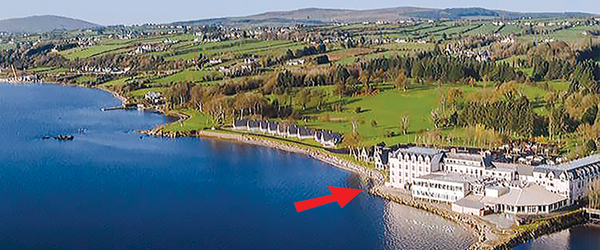
This from my friend, Sheila, ‘A fella from Ballyhahill told me I was "homely." It was later explained that this was a compliment.’ The highest praise one can garner is to be described as ‘daycent’. A really wonderful person would be daaaycent. And an all around great person is ‘massive’. One day I was strolling around the lovely town of Glin on the Shannon estuary with my cousin, Fr. Mick O’Connor. We were admiring Barrett’s Bar, the castle and the waterfront park. Mick said the village reminded him of a saying in admiration of a nice-looking girl. “If she were a town, I’d cycle through her”. Glin is one of those towns you don’t want to bypass.