



The National Irish Famine Way is delighted to announce plans for the expansion of the Global Irish Famine Way (GIFW) to the United States in 2026. To support and coordinate this expansion, the organization has appointed two well-known individuals from the Irish community as national U.S. Co-Convenors: Professor Christine Kinealy of Quinnipiac University, Connecticut and Hilary T. Beirne, from Roscommon, Former Chairman of the NYC St. Patrick’s Day Foundation and Founding Director at Irish America 250.
The first phase in the United States will install Bronze Shoes at key historical sites in Boston and in New York in 2026. For subsequent phases, the Co-Convenors would then invite other community-led efforts across the United Staes to participate in the expansion of Global Irish Famine Way to other locations. The U.S. Global Irish Famine Way will join the Global Irish Famine Way Canada, which was established in 2025. This initiative will be especially meaningful to descendants of the Irish Famine, and Irish America, as it will feature as part of the Irish America 250th commemorations in 2026.
‘For many Irish Americans, the Great Hunger, along with lesser-known famines, remains their foundational story for being in the United States. The National & Global Irish Famine Way provides a tangible memorial to the resilience of those emigrants and exiles who ultimately triumphed over adversity’, Professor Kinealy observes.
‘This is a hugely exciting development for the GIFW. Irish Famine emigrants made a major contribution to the United States. Exile from Ireland because of the Famine is an intrinsic part of Irish American heritage and identity. There are over forty memorials to the Famine in the United States. The Bronze Shoes will connect not just these sites but the story of the Famine Irish and the ascent of following generations within America. It will also connect Irish America to the global phenomenon of Famine emigration, from North America to Australia.’ says former Canadian Ambassador Eamonn Mc Kee, now co-convenor of the International Global Irish Famine Way with Caroilín Callery.
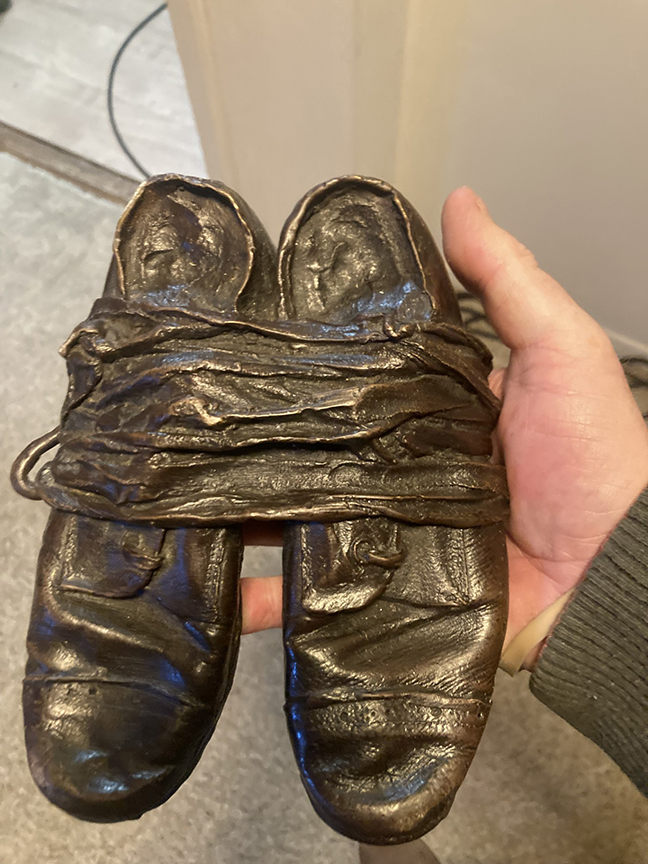
As with the Irish National Famine Way the Global Irish Famine Way will be marked by Bronze Shoe plinths placed at significant sites, including ports of entry, quarantine stations, and common graves. Each site will include a QR code sharing its local history and the QR code will be linked to a dedicated page on the fully bespoke National & Global Irish Famine Way website (www.nationalfamineway.ie ). The bronze shoes, cast from originals discovered bound together in the roof of a 19th-century cottage, forms the trail’s iconic symbol “Bronze Shoes.” The National Famine Museum and National Famine Way, managed by the Irish Heritage Trust, stretches 165 km (102 miles) from west to east across Ireland along the Royal Canal to Dublin, marked by 30 pairs of bronze children’s shoes, and ends at the iconic Famine Statues on Custom House Quay.
‘Interest in our evocative, powerful and deeply symbolic little Bronze Shoe monument grew so fast’ says Caroilín Callery, founder of the National Famine Way, ‘they have quickly become symbolic of all famine emigrants worldwide. People seemed to connect with them instantly, often simply touching or saying a little prayer over them.’
The journey of Strokestown’s 1,490 emigrants—and all famine emigrants—did not end on Dublin’s quays, so the expansion of the Global Irish Famine Way continues their story, honouring those who died and celebrates the survival and the resilience of those who built new lives abroad. The Global Irish Famine Way plans to tell the story of every place around the world where Irish Famine emigrants landed, creating new lives so far from their native land. Following in the footsteps of Strokestown’s 1,490, the Global Irish Famine Way initially expanded to Canada in 2024 with 15 pairs of Bronze Shoes in key locations. The United States is the next natural step as we reach out globally to the destinations where Irish Famine refugees arrived between 1845 and 1852. We know hundreds of thousands fled on the Coffin Ships for American shores – including many of Strokestown’s Missing 1,490 whom we know made their way to the US.
“The famine crossed the Atlantic in the coffin ships, and those who arrived in the new world were deeply scared as a result of it. The expansion will ensure acknowledgment of a shared history that is part of the Irish American psychic, it is also very much part of the American story. Many of my ancestors died in the famine and are buried in the same graveyard as my parents in County Roscommon, so I am proud to help facilitate the expansion of the famine way into the United States,” said Hilary Beirne.
When completed, it will be the longest heritage trail in the world, with dedicated local sites reaching back to a central location, the National Famine Way trailhead at the National Famine Museum in Strokestown, Co Roscommon, Ireland. As both a physical and digital heritage trail, the Global Irish Famine Way aims to create an international network extending as far as Australia, telling—for the first time—the full story of the global impact and legacy of Irish Famine emigrants of which the US plays a key and central part in that story.