
Based on a true story
Celtic Knot
Author: Robert Patrick Conlon
Genre: Historical Fiction / Family History
Publisher: Eckhartz Press
ISBN: 979-8-9929389-2-0
Available at https://eckhartzpress.com/shop/celtic-knot/
Amazon and others
One moment can change your life forever. For eight-year-old Tim, this occurred when both of his parents, immigrants from Ireland, perished in 1885. Separated from his siblings, friends and the only world he knows, Tim becomes a resident of an orphanage northwest of Chicago where he encounters an ill-intending priest. Tim executes a harrowing escape and returns to live on the rough and tumble streets of Chicago.
He encounters the red-light district, tuberculosis, smallpox, the Spanish flu and the mob in a notorious time in Chicago history which includes the Iroquois Theatre
fire, the Eastland Disaster, and more. Using his smarts and will to survive, Tim’s unceasing desire to again experience love of family keeps him alive through extraordinarily challenging events.
Reviews
“Take an orphan whose childhood reads like Charles Dickens, set his essentially true story in the epic and tragic boom town of early 20th century Chicago, share the amazing account of that young Irish-
American boy’s rise to manhood and success in such a dynamic, turbulent city, sprinkle in a little Irish magic and you’ve got the Celtic Knot.
Bob Conlon’s narrative of his grandfather’s life is told with love, humor, charm and more than a few page-turning tales of adventure.
A work of non-fiction with a little poetic license and a wink of imagination thrown in. "How very Irish.”
Brendan Sullivan, author of "The Living Wills“
“This is as much the story of Chicago growing up as it is Tim Conlon growing up. Both suffered growing pains, and both emerged battle weary, but still standing strong.”
Sally Armstrong, The Beacher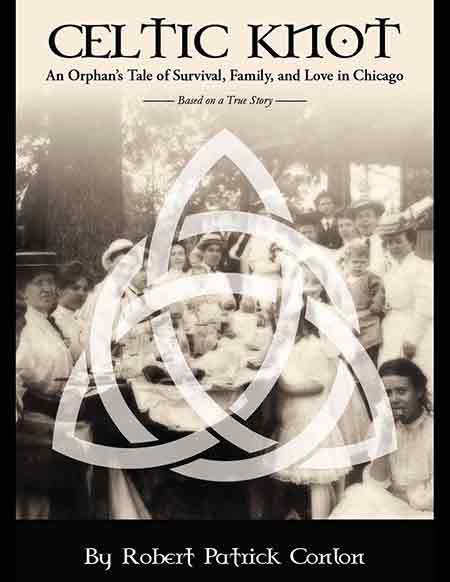
“A dramatic escape from an orphanage run by a pedophile monk, a young orphan’s harrowing story of survival in Chicago’s red light district, avoiding a mobster’s hit after witnessing a murder, and banshees visiting the family home.
Celtic Knot has all this, and then some.
Through the lens of his grandfather, Robert Patrick Conlon spins a non-fiction account of fin du siecle Chicago. But in doing so, he inspires introspection into all our ancestry, especially immigrant ones.
Tim Conlon suffered unimaginable loss at the tender age of eight. He lost both his mother and father in quick succession, and was sent to the Queen of Heaven orphanage in Arlington Heights, Illinois, separating him from his siblings.
Queen of Heaven was run by Brother Duvalle, who turned out to be a pedophile. Duvalle would enter the young boys’ sleeping quarters in the middle of the night and molest them. Young Tim knew he had to escape Queen of Heaven with all deliberate speed, and so he hatched a plan to escape with one of his fellow orphans, Billy. Tim arranged to take the rap for one of Billy’s peccadilloes so he could be punished by having to stand all day on a tall tree stump out in the orphanage’s yard. From that perch he was able to see exactly when and where the horse-drawn bread delivery truck came during the day so he and Billy could time their escape.
Tim and Billy executed their escape in the bread truck just about perfectly, except Brother Duvalle, a/k/a “The Devil,” sent law enforcement after them with hounds. As the dogs neared, Tim knew they would be able to follow both of their scents, so Tim told Billy they would have to split up to throw them off. The plan worked, and Tim was ultimately able to make it all the way to Chicago.
Tim disappeared in “Little Cheyenne,” then Chicago’s red light district in what is now the South Loop. He survived by cleaning up and crooning at a bar owned by a character called “Mush Mouth.” He would also sometimes sleep at a brothel, where he met his first crush, a beautiful 16-year-old Polish lass named Cora.
Yet Brother Duvalle came after young Tim, fearing Tim would reveal the Devil’s depredations to law enforcement or the Church. Duvalle hunted Tim down in Little Cheyenne, leading to some close encounters.
Eventually Tim gets a job with Western Electric, where he ultimately obtains no fewer than 22 patents. This with nothing but a second grade education, save for a voracious reading appetite.
It was at Western Electric where he meets the love of his life, the author’s paternal grandmother Mae, who is a toll call operator there.
Mae is some kind of clairvoyant with an unusual penchant for and ability to read tea leaves. She not only foresees the famous fire at the Iroquois Theater, but the Eastland disaster as well, enabling Tim and his family to avoid their potential demise.
Celtic Knot became quite personal for me, as I suspect it might be for many if not most children, grandchildren, and great grandchildren of immigrants.
For example, my own paternal grandfather was also an orphan and had to spend some time at an orphanage in New York. God knows what kind of travails he suffered there. Hopefully not the sexual predations of the orphanage’s operators.
Like Tim Conlon, my own grandfather was also substantially self-educated as a voracious reader, eventually owning a book store near the site of the old World Trade Center.
Mr. Conlon is fortunate enough to have much of his grandfather’s history documented, including a substantial amount of poetry, which Mr. Conlon uses to great effect to illustrate his grandfather’s intense love for Mae, among other things.
Although Celtic Knot is primarily about the Irish immigrant experience, it transcends ethnicity to touch the descendants of all immigrant families. It concludes in an extraordinarily spiritual way, with the symbolism of the triquetra, the ancient Celtic symbol of birth, life, and afterlife.
Celtic Knot had me pining for more, especially a movie version.”
James A. Shapiro, Chicago Literary Club, President
About the Author
Robert Patrick Conlon has been a trial attorney since 1985 representing businesses in commercial disputes across the country.
He is a Founding Partner of Chicago based law firm, Walker Wilcox LLP.
Robert and his wife, Pam, have worked and lived in Chicago and the Western Suburbs throughout their married life. They have three adult children and six grandchildren.
Target Audience
I believe people interested in the following subjects will enjoy Celtic Knot:
Historical Fiction;
Chicago History from the mid-1800s through the mid-1900s. The novel covers the Chicago Fire, and the great rebuilding that ensued. Also, the protagonist has close brushes with the fire at the
Iroquois Theater where more than 600 people died and the Eastland Disaster, where 844 souls perished in twenty feet of water in the Chicago River, while still tied to the moorings;
Immigration to the United States
- the novel discusses the Irish and Scottish influx to the States, in particular Chicago, coinciding with the Potato Famine of 1845;
Family History and Ancestry
- the novel explores family roots, ancestor’s sacrifices and how that shaped who we and our country are today;
Survivors of Sexual Assault;
Orphans and Homeless Children;
Coming of Age Stories;
The Small Pox, Tuberculosis and the Spanish Flu Epidemics at the turn
of the 20th Century;
Irish Lore, Mythical Creatures, and Banshees;
The early Chicago Mob; and Family Bonds and Love.