Protestant Writes Stories of Bloody Sunday Victims

by Wil Ralston

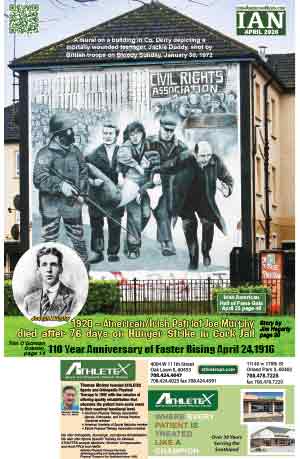
On January 30, 1972 the British Army conducted an arrest operation in Derry during a Northern Ireland Civil Rights Association march. During the protest, fourteen unarmed marchers were shot and killed and another fourteen were seriously injured. The day has since been known as "Bloody Sunday."

In 2003, Jennifer Faus traveled to Northern Ireland to tell the stories of the men and boys murdered on Bloody Sunday. A single mother of three, she commuted between Derry and Chicago for two years documenting the lives lost. These stories have recently been released in the U.S. as a collection entitled Before Sunday.

I am cleaning furiously. She’s scheduled to arrive in ten minutes and it’s just occurred to me my house ought to be spotless. Phantom is barking over the noise of the vacuum and his insistence causes me to switch it off. He is right. There is a soft knocking at the door. Usually content to bark from a distance, he shoots through the opening door and leaps into my guests arms.

Here, standing at my door, holding my dog as he licks her face, is the woman who traveled five hundred miles so a college student could interview her for a class project. I am horrified. Before I can apologize, she looks at Phantom and speaks to him, “Fancy a walk?”

As quickly as he leapt into her arms, Phantom is back in the house. I am still standing open-mouthed when Phantom returns, leash in mouth, tail wagging. He’s forgotten I exist. She’s down next to him putting on his leash, “You’ll have to let your daddy walk you. I’ve got two of my own.” Now they are both looking up at me expectantly. “Do you mind?” she says, straightening up and handing me the leash, “I’ve got mine in the truck.”

I obediently follow her as she skips down the stairs. She is old enough to be my mom. Is she really skipping? Out of a giant black jeep, two enormous dogs emerge. As the three of them gracefully fall into step with Phantom and me, I notice they look like Bloodhounds. Inky, smooth, shimmering black Bloodhounds. “Blabs,” she says, reading my mind. “Bloodhound-labs. Got them from the rescue.” The dogs regally ignore me and my suddenly puny-looking Cocker-spaniel.

In my mind, a single mom who, while raising three children and working full time, travels to Northern Ireland to write the biographies of complete strangers is a vivacious sort of person. But here, walking beside me is a quiet, relaxed, gentle soul. The wind blows her wild mane of chestnut hair and she turns her green eyes to me, “So, you are taking a journalism class. Tell me about that.”

We walk the dogs and I tell her about my life. Two hours later the tail lights of the jeep illuminate my thoughts: I am going to flunk journalism. I see my grade and my not-yet-realized career flash before my eyes. I spent our interview time talking about me. Nonetheless, it helps me understand why forty-two Northern Ireland Catholics sat down with one American Protestant and poured out their hearts. They told her the stories of their slain brothers, fathers, and sons and she listened.

Later, she will tell me, “It has nothing to do with Protestant or Catholic. Put that fact out of your mind. I have no religious or political agenda. I am a mother. I heard a quote on NPR the other day, ‘Every mother is a jewish mother,’ and the thing is we are all Protestant mothers and Catholic mothers, and Muslim mothers, etc. So when any mother’s son is gunned down, is murdered in the street, you’ve got to say something, to do something. I couldn’t look at the faces of those men and boys and not know their stories.”

According to Paul Greengrass, Academy Award nominated director of Bloody Sunday and United 93, “Jennifer Faus has done something extraordinary and poignant. Reaching into the heart of this violent and controversial event, she allows us to hear, as if for the first time, the innocent voices of those who died that day and those who were left behind.”

Two days later she is on the phone: “Well, we’re not in the middle of nowhere but we can see it from here.” She’s decided to go on to Colorado to “have a hike and smell the fresh air” before heading back to Chicago and she’s on the long stretch of 70 that makes everyone want to just forget it and turn back. It sinks in a little how she just happened to turn up at the Bloody Sunday Family Centre Northern Ireland one day. She wants to know how my recent journalism test went, but I am on to her.

In the meantime, I’ve learned Verbal Magazine had this to say about her book: “Faus does an exceptional job of painting a picture of who these people were and what their lives were like without sentimentality or whitewash.”

Books available about Bloody Sunday detail the events and aftermath of Bloody Sunday but one piece has been missing – the human faces of the tragedy. Each of the thirteen stories in the book shows a unique individual (one family was unable to participate). Faus told me she hopes each reader finds one person they connect with in the book.

Reading Before Sunday, I found several: Hugh Gilmour is the daredevil I wish I could be; William McKinney is working to become a journalist; and Willie Nash’s family is funny and crazy - just like my own. In writing Before Sunday, Faus hopes readers learn the human stories, not just that fourteen were killed, but that fourteen also lived.

Ivan Cooper, a civil rights activist and former MP who helped spearhead the book and saw Faus nearly every day she was in Northern Ireland had this to say: “Jennifer conveys a very touching insight into the personalities who were taken from us on Bloody Sunday. The events of that day were a watershed in terms of Irish contemporary history. Jennifer personalized our loss. Her commitment to the families and personal sacrifices to write Before Sunday have been enormous.”

Speaking with her, it seems the project was somewhat seamless, “Yeah, the logistics could be challenging, but it was just so great working with the families. Sometimes I would get frustrated by the process but that was usually because I didn’t understand, or I was being stubborn.” Personal sacrifices are not something she mentions.

The quietness I saw the day we walked the dogs belies her schedule. One week in Northern Ireland could be three single spaced pages of dates, times, places, and detailed instructions at home. For example: Monday and Tuesday kids with Matt and David; Wednesday G-ma in town; Thursday Steve and Steve pick up kids from school and stay the weekend. I’m home Monday - will get the kids at school. In addition, lists of activities’ times and places, preferences and needs, chores, and, in bold, Read the list on the front door everyday before you leave! Nine emergency phone numbers on the bottom, three belonging to her - each a different country code.

I ask her how she does it and, unassumingly she tells me, “My kids are amazing. Really flexible and forgiving. It wasn’t just me working on the book, as you can see from that schedule an army of people helped my kids and stayed with them when they couldn’t travel with me.”

Another child is grateful Faus took time away from her own children - an email from victim Paddy Doherty’s daughter, Karen, reads: “I have just read your story about my father and I have to say I am very emotional. You have got daddy one hundred percent. It just summed up my relationship with him and the man he was. I think the ending is perfect and I’m glad to say my sister Colleen thought it was great even though she can't remember him. It means so much to her just to hear all those things about him after all these years.”

It seems to me the families appreciate Faus' work, but she tells me she is the lucky one. “They trusted me to tell their stories. I was a stranger and they took a leap of faith. We all sort of jumped in and they told beautiful, touching stories about the men and boys they loved. Who am I to have the honor? Who am I to get the gift of hearing Mrs. McKinney tell her son’s life story - to hear her beautiful voice, see her expressions, be in the same room with her deep sorrow? You read me that quote from Verbal, well, to me, Before Sunday is not a sterile biographical account, it’s a book of love stories.”

Before we hang up, I ask if it’s true that a Bloody Sunday family member asked her out of the blue one day if she would write his brother’s story? And is it also true she volunteered? “Yes, Mickey [Willie McKinney’s brother] asked me and I said I would. And yes, it was simply the right thing to do. The proof of that isn’t in my volunteer hours, it’s all the others. I mean, none of my friends or family who put in hours with my children, read drafts, and helped transcribe interviews, asked for anything. We were all in it together.”

Would she do it again?

“In a heartbeat.”

Wil Ralston is a student at the University of Kansas

EXCERPT from Before Sunday: Hugh Gilmour Hugh was the baby of the house. The youngest of nine, small and wiry, his family called him the German, in honour of his flat head. Keeping track of Hugh was no easy task and two brothers, Bernard and Floyd, were assigned to look after him. Every day Bernard and Floyd were sent – ‘Get Hugh. Bring Hugh in. Go see where Hugh is. If he’s in a safe place, well, that’s OK, stay there.’

Hugh Gilmour was born at 16 Springtown Camp, 1954. The entire Gilmour family lived together in Springtown. The four girls, Olive, Doreen, Sara, and Brigid in one bedroom; the boys, Tony, Bernard, and Floyd in the other – packed like sardines. Hugh, being the baby, stayed with his parents Henry and Kathleen. ‘They must a thought we’d smother him, or choke him, or maybe we’da been that hungry sometimes we’d probably eat him,’ said Bernard, ‘Keep him away, they’ll probably eat him.’

Hugh was perhaps the nuttiest member of his family, but being the youngest earned him a coveted place in the household pecking order. According to his brothers and sisters, Hugh’s position meant he got more than they ever did. Not that the family had much but, while his seven brothers and sisters went to school without shoes, Hugh always had them. While the rest of the siblings regularly beat the hell outta each other, nobody was allowed to touch Hugh. He wasn’t to be hit. ‘He’s too small.’ If the brothers touched the German, his mother and sisters rallied to his defense.

Fortunately enough, it never became an issue. Hugh was his mother’s world and his mother was Hugh’s. One of his great loves in life. The other children were sensible enough to watch themselves. The German went head-long into anything. So Kathleen employed them, Olive, Tony, Doreen, Bernard, Floyd, Sarah, and Brigid, one after the other to watch after Hugh.

The family moved from Springtown in 1960 to a small street in the Bogside called Pilot’s Row. Hugh lost no time making friends. These friendships were forged by freedom and geography. As soon as all of his six year-old self stepped out the front door, Hugh’s closest friends became Gerry Doherty, Jim Duffy, Jack McDonald, and Andy McCauley. Hugh was christened ‘Gilly,’ and although fate would intervene from time to time, the bond of these friends was unbreakable for the next ten years.

If ever there were a gaggle of ruffians roaming the streets, it was Hugh and his friends. Closed on Sunday, the docks provided plenty of opportunity for exploring and futtering about. The day might start with a walk from the top of the docks to the bottom. A bakery, called Hunters, dumped the days’ unused dough and pastry, which the boys collected for feasting and fishing up the docks. Along the way the boys took turns, ‘What if you went down here in the river and found a dead body …’ as they walked two miles back to the slaughter houses where pig entrails were flushed into the river.

Present at the right time, the moment of the flush, you could catch a mullet – the rat of the sea. Mullets would eat anything, and they feasted on pig entrails. With string lifted from building sites, the boys constructed lines, attached dough, and bobbed it on the surface of the water. When the mullet took the dough and went down, they hooked it, reeled it in, and chopped it up to use for bait to fish for flukes and eel.

Walking two miles to get a piece of dough to catch a mullet to cut up to fish for flukes made perfect sense to the boys because you could eat a fluke, a flat fish like a plaice. Once you knew what a mullet ate, nobody could eat it, but you could eat the flukes so that was the goal. There was an old crane at that part of the river, and the boys spent more time swinging on its hook than they did fishing. So they weren’t great fishermen, but they liked to think that they were.

In spite of their antics, Hugh and his friends were gentlemen. They pulled a lot of stunts amongst each other but remained polite and respectful to their elders. When it was time for Hugh to come in for his dinner or bed, his father whistled, a sharp twittering whistle. Hugh would whistle back and home he’d go, quick as a flash.

On 5 October 1968, Gerry and Hugh went down to the Templemore School football pitch for a game and no one showed up. So they spent an hour running around after frogs – just chasing frogs around the field trying to catch them. Tired of frog-chasing, they wandered down to the bottom of the pitch, which took them out onto the Buncrana Road where they could catch the bus back to town. They headed into town but the bus was diverted up along the back of the quay – which was unusual. The driver took them across the double-decker bridge and dropped them off at HMS Sea Eagle, a British Naval Base. They couldn’t figure out why the bus hadn’t stopped at the Guildhall but instead taken them all the way over to the Waterside. Nonetheless, they didn’t ask any questions and just headed back to town. They didn’t know there had been a baton charge up Duke Street through a civil rights march and that people were all beat up.

Hugh’s family had moved to the flats in 1965. By the end of 1969 the boys began to drift apart. They left school, got work, and developed different interests. Go-cart building and frog catching gave way to girls, jobs, and cars. Although steps away, they lived in different neighbourhoods. They made new friends and fell out of touch. The friendships closed and faded away as fate, geography, and politics intervened. But the memories of a wonderful carefree childhood endured.

Hugh was his mother’s son. She didn’t sleep until he was in at night. She sent Bernard or Floyd after him if it were past eleven. Hugh rested his head on her knee as they talked. She went to his room and watched him sleep. Hugh and his mother shared a deep and abiding love for one another.

30 January 1972 brought another civil rights march. Before he left for the march, Hugh gave his mother a half a crown for her birthday. He said to her, ‘That’s fer yer birthday.’ He wasn’t a huggy boy. He kissed her and said, ‘There, that’s all ye’re gettin.’ And away he went.

That evening Bernard was sent out for the last time to find the German. Everybody thought Hugh was wounded. At Altnagelvin Hospital Bernard said to a couple of boys, ‘Did ye see Hugh?’ ‘He’s over there. He’s wounded. Been shot in the arm.’ Sorting through the wounded in wards eight and nine, Bernard and Olive were unable to find Hugh. Bernard and Olive made their way to the morgue, identified Hugh, and went home to face their mother.

They went home with the news, ‘Hugh’s not wounded. He’s dead.’ Kathleen sat in denial until Hugh’s body was brought home. His beautiful face at peace, his appearance neat and tidy in his coffin belied his last moments of pandemonium and terror: people screaming, bullets flying, CS gas in the air, being advanced upon by black-faced soldiers trained to kill, lying in the arms of young marcher Geraldine Richmond crying, ‘Mammy! Get me Mammy!’

After the funeral; after Hugh’s coffin was lowered into the ground; after the cold sound of dirt hitting wood faded away, his family was left with a gaping wound. Gilly had been murdered. There was no more searching for the missing German; no more jokes; no more games. There was no more back to scrub; hair to tussle; not one darling boy to watch while he slept. Nothing to do but pass his room; go up to his bed; look at his clothes hanging in the closet still holding his form, waiting to be pulled out for another day at Northern Ireland Tyre. No broken toes to fill a slipper. No mischievous grin. No one left to push the wee A-40 into Gilly’s Car Park. Kathleen would never again receive a half-crown for her birthday or a wink and a smile.

Kathleen loved talking about Hugh up to the day she died. If anyone talked about Hugh, she loved it. But the television footage haunted Kathleen. There were the Paras entering the Bogside, ‘Hugh’s still alive. There look, in the crowd, is that Hugh there?’ Bernard would respond, ‘Naw that’s not him. Naw, he’s away down in the flats somewhere.’ But whenever that bit of the footage was played she insisted. ‘Hugh’s still alive there, look.’

Hugh’s family desperately wanted to stop time. If they could just step into that moment, go into the picture, and move Hugh from that place. If Bernard could just move time back twenty seconds when Hugh ran past him at the door, he could shout at him to come in. All Hugh needed was to hear his father’s sharp twittering whistle and quick as a flash, he’d be home.